TJBot
An open source DIY robot that teaches people how to program with AI, built by hundreds of thousands of students and makers worldwide.


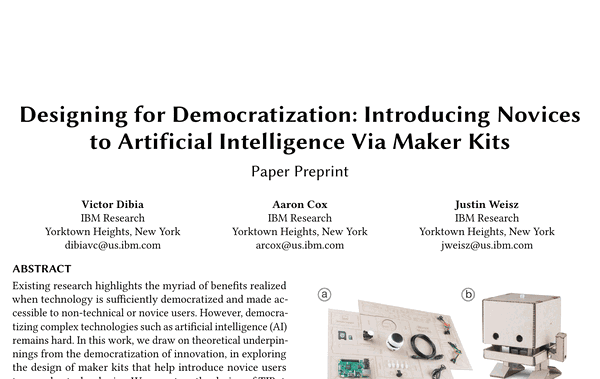
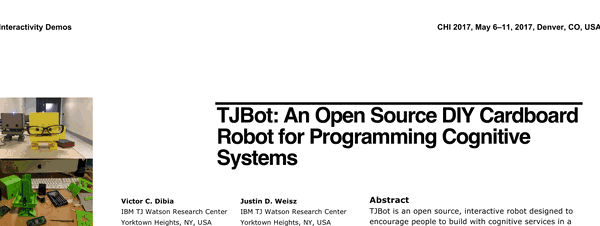
TJBot is an open source, DIY cardboard robot that makes it easy and fun to learn how to program with AI (Dibia et al., 2017; Dibia et al., 2018). Makers can laser cut or 3D print TJBot’s body, add a Raspberry Pi and a few inexpensive components, and then write “recipes” that let TJBot listen, speak, see, shine its LED, and wave its arm.
TJBot has been used by hundreds of thousands of students and makers around the world to learn about AI, cloud services, and robotics. I was part of the original team at IBM Research that developed TJBot and maintained it for many years. I was also part of a separate team that developed classrom activities for Vietnam’s Teacher’s Day, for which I received an IBM Volunteer Excellence Award.

TJBot Community Edition
If you’d like to build a TJBot today, start with TJBot Community Edition. I created this fork of TJBot’s software to keep it up to date with the evolving landscape of Raspberry Pi hardware, software, and cloud-based AI services. TJBot: Community Edition is built upon a modernized software stack:
- Programming SDKs: choose between TypeScript (node-tjbotlib) and Python (python-tjbotlib) for writing TJBot recipes.
- On-device AI: support for local speech-to-text, text-to-speech, and computer vision models.
- Hardware: supports Raspberry Pi 3B, 3B+, 4, and 5.